
There’s a particular kind of mental gymnastics Mothers are exceptionally good at, and I say this as someone who has personally competed at the Olympic level.
Something in Motherhood feels hard, and almost immediately we start looking for evidence that we’re doing it wrong.
We lose our patience with our kids and wonder why we can’t be calmer. We feel resentful toward our partner and decide we should probably be more grateful. We’re exhausted, overwhelmed, maybe fantasizing about checking into a lovely hotel and telling absolutely no one the room number, and somewhere along the way the question becomes: What’s wrong with me?
I’ve asked myself some version of that question more times than I care to admit.
When my son was born, Motherhood absolutely leveled me. I loved him desperately, which only made my struggle more confusing. I’d wanted this child and was enormously grateful for him. So what the hell was my problem?
Well, it didn’t take me long to decide the problem was, in fact, me.
I was a psychologist and coach, for heaven’s sake. I knew about emotional regulation. I’d spent years helping other people navigate difficult seasons of their lives, and yet there I was, struggling to navigate my own.
Talk about humbling, embarrassing, shaming… the list is long. I’m sure you get it.
But over the years, both through my own experience and my work with women, I started noticing something interesting that changed the way I understood Motherhood entirely.
Mothers are really quick to think they’re the problem.
You see, we rarely question the conditions. We question ourselves.
Now just think about how often this happens. A Mother is carrying the mental load of a household, keeping track of appointments, school forms, groceries, birthdays, childcare and the 47 other things required to keep a family moving. She’s trying to maintain a relationship, perhaps a career, and some recognizable version of herself. (The gall!) She’s depleted and starting to feel what we now commonly call Mom burnout.
And what does she think?
OMG. Why can’t I keep up? Maybe I need to be more organized?
Or maybe, just maybe, she’s short-tempered because she’s been interrupted 600 times and it’s only 11 a.m.! Someone can’t find their shoes, the dog threw up, and her partner keeps asking for the pediatrician’s number even though he can Google it just as quickly as she can.
She snaps.
Enter: Mom guilt.
And now she’s not just angry, but also feels terrible about being angry.
So this is where things get interesting to me because, yes, of course, personal responsibility matters. I’m a psychologist. I believe deeply in self-awareness and our capacity to change. If I behave badly, I want to own it. If I owe my child an apology, I give one.
But I’ve become increasingly interested in what happened before the moment we decided the Mother needed fixing.
Behold, my current mental list:
- What has she been carrying?
- How much help does she have?
- What does she believe a “good Mom” should be able to handle without complaining?
- How many times has she swallowed an entirely reasonable need because someone else’s felt more important?
In other words, what if her reaction isn’t the whole problem?
I call this The Motherhood Setup, a framework that explains why modern Motherhood feels so overwhelming, and why women are so quick to believe that feeling overwhelmed is their fault. What we call overwhelm in Motherhood is often the collision of three forces: The Motherhood Fantasy, Good Girl Conditioning, and the invisible labor required to keep a family running.
And because this is one of those things that makes even more sense when you can see it:
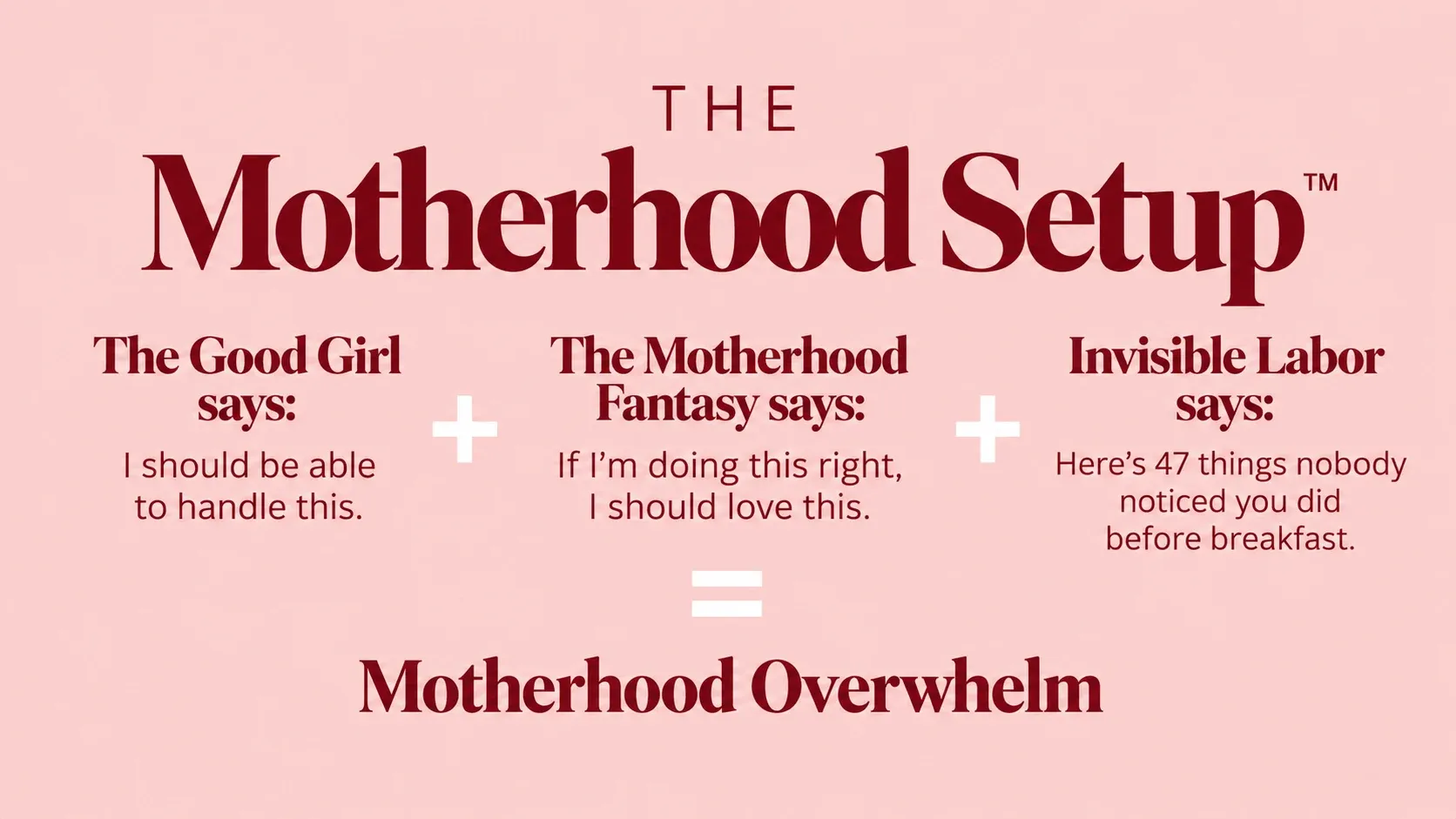
And boy-oh-boy, is that collision powerful.
Before becoming Mothers, many of us carry some version of what I call The Motherhood Fantasy, the story we’ve been sold that if you’re doing Motherhood “right,” it should feel natural, effortless, and spiritually fulfilling. So when it feels hard, isolating, suffocating, monotonous or overwhelming, a woman doesn’t question the fantasy. She questions herself and assumes something’s wrong with her.
And that fantasy can really distort what a woman thinks should matter.
Then there’s Good Girl Conditioning, the training so many of us get, spoken and unspoken, that says our job is to be agreeable, impressive, and low-maintenance at all times.
It’s the inner script that whispers: Be helpful, be nice, don’t need too much, don’t make anyone uncomfortable. Over time, that conditioning fuses worth with performance: if you are pleasing, productive, and pleasant, you’re “good”; if you’re messy, angry, needy, or disappointing to someone, you’re “failing.”
Motherhood gives that conditioning an astonishing amount of material to work with.
So when reality collides with what we thought we should be able to handle, we rarely think, Huh. Perhaps this job is significantly more demanding than our culture acknowledges.
Instead, we think, Why can’t I handle this better?
And suddenly being a Mom overwhelmed by an overwhelming amount of work becomes a character flaw.
Ta-da! Thank you to millennia of cultural conditioning and impossible expectations for women everywhere.
Even Mom rage, a term that can sound alarming when stripped of context, deserves a little curiosity before condemnation. Anger doesn’t emerge from thin air, people, and I’m far more interested in what happened before the anger showed up. Maybe a boundary has been crossed, or she’s been giving far more than she actually has available to give. Or perhaps she’s simply exhausted and someone has left a wet towel on the bathroom floor, again.
And sure, she’s furious about the towel, but we both know the towel isn’t really the point.
This is why I think language matters so much. When we name experiences like Mom guilt or Mom burnout, there can be enormous relief in realizing, Oh. Other women feel this too.
But I want us to go one step further.
Instead of only asking how to make the feeling go away, I want to know what the feeling is responding to.
Because there’s a meaningful difference between believing I’m overwhelmed because I’m failing and recognizing I’m overwhelmed because I’m carrying too much.
One requires me to become better at carrying the load.
The other allows me to question the load itself.
I explore this distinction throughout my work and in my book, Good Girl, Bad Mom, because I spent far too many years assuming every difficult feeling I had about Motherhood was evidence that something was wrong with me.
It wasn’t.
Some things were mine to work on. Of course they were. I’m a human being raising another human being, and neither of us is getting out of this thing without needing to apologize occasionally.
But some of what I was experiencing wasn’t personal failure at all. It was a perfectly understandable response to a role that asked more of me than I’d ever imagined while simultaneously convincing me I should be handling it better.
And I suspect I’m not alone.
So the next time you find yourself wondering why you’re not more patient, more grateful or simply better at all of this, perhaps resist the urge to immediately put yourself on trial.
There may be nothing wrong with asking, What could I do differently?
I just don’t think that should be the only question.
Sometimes the more revealing one is:
What am I responding to?